Probably the best wide angle zoom lens on the planet at the moment is Nikons 14-24 but it does have one problem-you cant use filters with it due to the bulbous front element-Until now, Lee filters have designed a new huge filter system purely for this lens, i am sure its going to be very expensive but i am glad that they have taken the time to get it sorted-its a brilliant lens and deserves a descent set of filters
see here
Another thing is that Lee Filters have a new 10 stop ND filter out, I will get one of these as soon as they are available over here
Details from www.wildlifeacrossthewater.blogspot.com
Dave
Showing posts with label Lee Filters. Show all posts
Showing posts with label Lee Filters. Show all posts
Saturday, 13 March 2010

Wednesday, 28 October 2009
Work the area

I visited one particular spot on a small river in the smokey mountains, It was extremely scenic and the trees were nice shades of yellow, The first time i arrived there was already a photographer there, I let her shoot whilst i had a quick look around at various angles imagining the images in my mind, She took some shots at track level and went, I say track level as we were above the river-see the image above, I shot a few images and some more photographers arrived and took the same image, I worked that part of the river and then decided i would return and try again in different conditions and when the area was quieter, This one particular stretch of river seemed to have unlimited possibilities but all the photographers that i watched shooting there all took the same images, I returned and when the area was free i clambered down the bank and set up at water level and spent a pleasurable hour shooting all kinds of angles of the same scene and still felt that i hadn't covered half of what a good landscaper could walk away with, Here are a few of the images taken-all HDR of the same scene, I shot the whole time with my D3 and 24-70, I used a Lee filters Circular poloriser to reduce the reflections and enhance the colours, My camera was set to manual mode and daylight white balance, I took test shots to get a perfectly exposed image and then bracketed both side +/- 1 and 2 stops giving 5 images in HDR to create one, In the portrait mode image i also used a 2 stop Lee grad filter at an angle to tone the bright trees on the right of the image, Landscapes don't move so you can take your time and explore the scene,If the area is a good one make sure you return at different times of the day/year and in different conditions


Dave
Monday, 3 August 2009
Front filter for big lenses?
We spend a fortune to get a big lens-300mm+ yet we cant get a protection filter to fit on the front why? well firstly they would be huge and secondly most big lenses have one already built in-yes that right, The front glass on big lenses is a protective filter pure and simple and not part of the actual focusing/image quality glass, Look at this diagram of a Canon 600F4

Note that the front element is a flat piece of glass but all the others are curved, Now i am not saying that its not an optically perfect piece of glass as it would be on a quality filter for a smaller lens,all i am saying is that the only part it plays is to protect the inner lens elements and thats the reason we cant fit other filters to the front and filters are generally drop in's, Check out the block diagrams for your lens to see if yours has a filter built in-i believe even Canons 300mmF4 has
Dave

Note that the front element is a flat piece of glass but all the others are curved, Now i am not saying that its not an optically perfect piece of glass as it would be on a quality filter for a smaller lens,all i am saying is that the only part it plays is to protect the inner lens elements and thats the reason we cant fit other filters to the front and filters are generally drop in's, Check out the block diagrams for your lens to see if yours has a filter built in-i believe even Canons 300mmF4 has
Dave
Wednesday, 8 April 2009
Gear we use and Abuse - Graduated Filters
Although Dave and I are primarily wildlife photographers, we both do a bit of landscape photography too. There is a natural fit really with the places that we go and see.
Now the best landscape photography is all about light and how we use it to the best of our ability. The same scene can have many different looks as a result of the different light from the different times of the day and at different times of the year with the sun is at a different height.
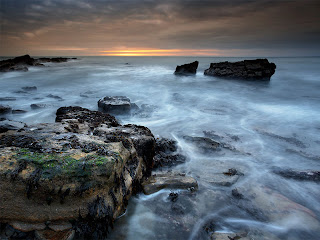
One of the tools that we can use to help us control that light is the Neutral density graduated filter, or ND grad as they are known for short.
The image above used a 2 stop hard edged ND grad to hold back the brighter sky and allow me to get detail in the much darker foreground.
Both Dave and I use the Lee Filters system. It is quite expensive as filter systems go, but as the old mantra goes 'You get what you pay for'.
Today I will cover just the resin filters that I use. Later blogposts will cover how we attach to the camera and also the use of polarising filters.
Lee sell ND grads in sets of three ranging from 1 stop to 3 stops, which they sell 0.3, 0.6 and 0.9. The number of stops indicate the amount of light that they 'hold back'.
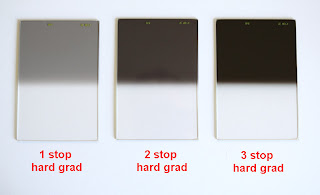
This image shows the full set of the hard edge grads. the term hard edge refers to the transition from the filter through to the clear. Hard meaning the transition is short and soft where it is more gradual as you will see below.

On this image you can see the difference in the transition between hard and soft.
I would tend to use the hard edge when I shooting seascapes like the image above and then use the soft edge when I might have some parts of the image in the filtered part where I want less filtration. You have to be very careful, particularly with mountain landscapes that you don't end up with heavily darkened parts of the scene as well as the sky.
This is one area where I use a special filter that I had made to order which is the blending filter (last filter on the right in the image).
This filter goes from 3 stops at the top and blends evenly to zero at the bottom with no harsh edge stops. This is one of my favourite and most often used filters to give methat gradual transition and avoid the obvious steps.
One useful tip I learned was to use the DOF preview button to better see the effects of the filter. More modern cameras have live view and with a combination of that, the histogram displayed and the DOF button depressed, you really can see every bit of information you need and mistakes or wasted shots really shouldn't occur - but we will still make those mistakes - I know I do.
So look out for future posts on the rest of the system and polarisers
Martin
Now the best landscape photography is all about light and how we use it to the best of our ability. The same scene can have many different looks as a result of the different light from the different times of the day and at different times of the year with the sun is at a different height.

One of the tools that we can use to help us control that light is the Neutral density graduated filter, or ND grad as they are known for short.
The image above used a 2 stop hard edged ND grad to hold back the brighter sky and allow me to get detail in the much darker foreground.
Both Dave and I use the Lee Filters system. It is quite expensive as filter systems go, but as the old mantra goes 'You get what you pay for'.
Today I will cover just the resin filters that I use. Later blogposts will cover how we attach to the camera and also the use of polarising filters.
Lee sell ND grads in sets of three ranging from 1 stop to 3 stops, which they sell 0.3, 0.6 and 0.9. The number of stops indicate the amount of light that they 'hold back'.

This image shows the full set of the hard edge grads. the term hard edge refers to the transition from the filter through to the clear. Hard meaning the transition is short and soft where it is more gradual as you will see below.

On this image you can see the difference in the transition between hard and soft.
I would tend to use the hard edge when I shooting seascapes like the image above and then use the soft edge when I might have some parts of the image in the filtered part where I want less filtration. You have to be very careful, particularly with mountain landscapes that you don't end up with heavily darkened parts of the scene as well as the sky.
This is one area where I use a special filter that I had made to order which is the blending filter (last filter on the right in the image).
This filter goes from 3 stops at the top and blends evenly to zero at the bottom with no harsh edge stops. This is one of my favourite and most often used filters to give methat gradual transition and avoid the obvious steps.
One useful tip I learned was to use the DOF preview button to better see the effects of the filter. More modern cameras have live view and with a combination of that, the histogram displayed and the DOF button depressed, you really can see every bit of information you need and mistakes or wasted shots really shouldn't occur - but we will still make those mistakes - I know I do.
So look out for future posts on the rest of the system and polarisers
Martin
Subscribe to:
Posts (Atom)